Webinar: AI, Automation & RE
In this session, led by Marlisa Post, Database Specialist with Donor Database Experts, we explored AI and automation, emphasizing their use in freeing up time from manual tasks for strategic work. The session differentiated between predictable, rule-based automation (like basic workflows) and reasoning-capable AI, which enables personalization but requires careful verification.
Here are 3 key takeaways from the webinar:
- Understand the Difference Between Automation and AI
- Automation is Rule-Based: Functions on predictable, simple “if-then” logic (Raiser’s Edge NXT Workflows are an example). It’s great for repetitive tasks and is generally safe.
- AI is Predictive and Personalized: Software that can learn, reason, and make predictions, enabling personalized communication and analysis.
- The “Trust but Verify” Principle: AI is not infallible and can make factual errors (“hallucinations”). It must be carefully verified, especially when dealing with specialized or sensitive data.
- Focus on Practical Tools for Efficiency
- Free Up Time: The main goal is to shift staff from manual tasks to work that requires human “thought and finesse” and strategy.
- Use NXT Workflows to Start: A simple, no-code way to automate tasks like a new donor welcome series or adding actions for big gifts.
- Leverage Power Automate for Complexity: A low-code tool for building integrated, multi-step processes across over a thousand apps (e.g., updating donor records via a form).
- Utilize Power BI for Reporting: A powerful tool for data visualization, deep analysis, and creating reports that surpass the capabilities of standard NXT dashboards.
- Implement Gradually and Safely
- Start Small and Scale: Begin with simple projects and build on successes rather than trying to automate everything at once to prevent frustration.
- Create Guardrails and Playbooks: Establish clear rules for how and when AI tools are used within the organization to control autonomy and prevent unwanted actions.
- Protect Donor Data: Always remove personally identifying information (PII) before feeding large datasets into general-purpose AI tools (like ChatGPT), and check settings to ensure data isn’t used for training future models.
- Maintain Ownership and Skills: Use AI as an assistant or teaching tool, but don’t rely on it so heavily that employees lose their core professional knowledge or ability to code and analyze.
Related Posts
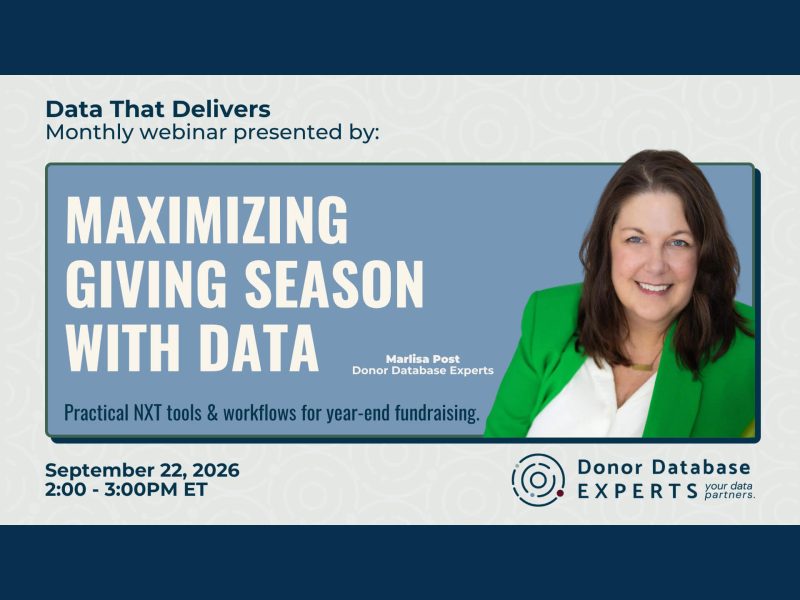
Webinar: Maximize Giving Season with Data
Learn how data cleanup, donor segmentation, flexible giving options, and thoughtful stewardship can strengthen year-end fundraising.
Webinar: The Great NXT Migration
Explore the Raiser's Edge NXT migration, including what to move to web view now, which features add value, and what can stay in Database View.
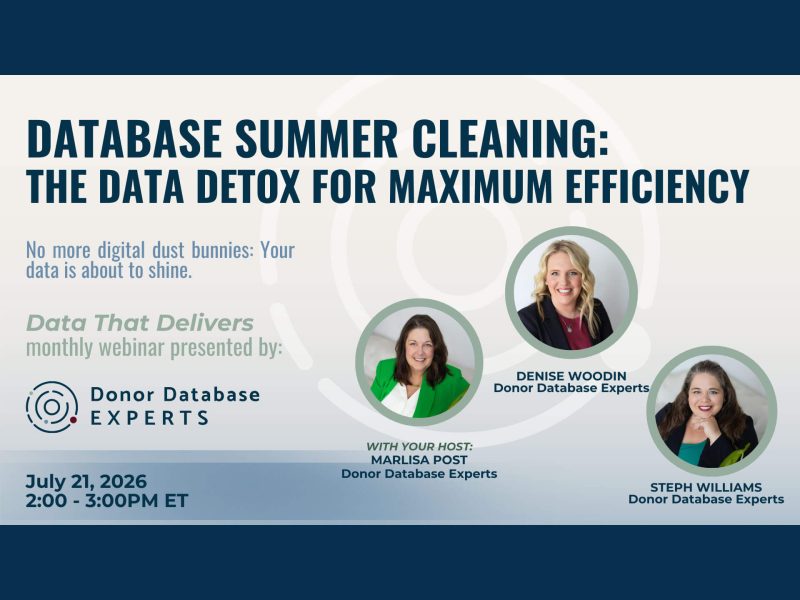
Webinar: Database Summer Cleaning
In this webinar, we discussed how to identify and clear out digital clutter across every layer of your database.